
Trigger Warning: This article contains descriptions of physical and emotional abuse.
The conversation surrounding “daddy issues” is a well-worn path in modern psychology and pop culture. We often discuss the void left by absent fathers or the damage caused by patriarchal authority figures. However, there is a quieter, more suffocating trauma that remains largely shrouded in taboo: the harm caused by toxic and abusive mothers.
In a society that deifies motherhood as an inherently selfless, saintly pursuit, admitting that a mother can be a daughter’s first bully feels like a betrayal. But recently, a singular piece of digital art blew the doors off this domestic silence.
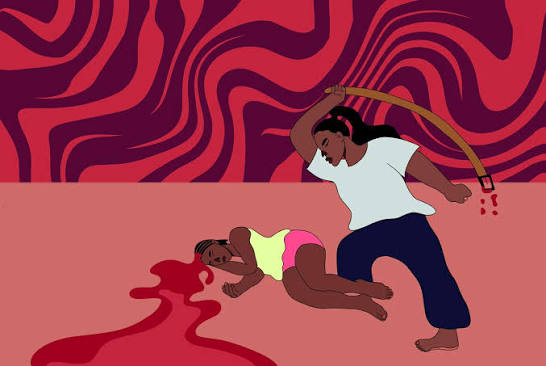
Artist Cynthia Ugwudike shared a haunting illustration titled “And She Saw Me Bleeding” from her collection “Does My Mother Love Me?” The image, which depicts a mother beating her daughter as blood pools around her, went viral on X. It sparked a visceral, heartbreaking outpouring of testimonies from women who recognized their own childhoods in that digital ink.
One user recalled a harrowing moment of physical violence: “I remember my mother threw a pair of hair shears at me, aimed straight at my head. They struck and penetrated deeply into my temple. She rushed over to remove them gently as I bled uncontrollably. Then, she started crying, not out of remorse for my pain, but begging me not to tell my father because she was afraid he would beat her in return.”
Another woman shared how even the smallest infractions led to brutality: “I ran away from home when I was 12 because my mom beat me so severely for making a Nutella milkshake and then lying about it. I was overweight at the time and was not allowed junk food.”
These stories highlight a grim reality: for many, the home is not a sanctuary, and the mother is not a protector.
Why Does Maternal Abuse Happen?
Psychologists suggest there is no single catalyst, but rather a complex web of factors. For some, it is displaced anger—the mother redirects the frustration she feels toward a spouse or a restrictive society onto the only person she has power over: her child. For others, it is intergenerational trauma, where a mother simply repeats the harsh parenting she survived, believing it to be the only correct way to ‘train’ a child.
In darker instances, the abuse stems from jealousy or a desire for absolute control. A daughter’s youth, beauty, or burgeoning independence can feel like a threat to a mother who feels powerless elsewhere in her life. This emotional immaturity makes it impossible for her to regulate her reactions, leading to a cycle of insults, manipulation, and physical punishment under the guise of “discipline.”
A Guide to Surviving Parental Abuse:
If you are currently navigating an abusive parental relationship, the path to healing is rarely linear. Experts suggest several strategies to protect your well-being:
- Call abuse what it is: Constant insults, humiliation, threats, manipulation, intimidation, physical violence, or controlling every aspect of your life are not “just how they are.” Naming the behavior helps you stop internalizing it.
- Stop trying to win their approval: If you’ve spent years trying to be “good enough” and the goalposts keep moving, recognize that their treatment may not be about your worth. Protecting your self-esteem sometimes means accepting that you cannot earn healthy behavior from an unhealthy person.
- Don’t engage during explosive moments: If you know a confrontation is escalating, prioritize safety over proving a point. Keep responses brief, leave the room if you safely can, or delay the conversation until emotions have cooled.
- Set boundaries where possible: Examples include: “I’m willing to discuss this, but not if I’m being yelled at”; “I’m leaving this conversation if you continue insulting me.”; “I’m not discussing my personal relationships.” Some abusive parents ignore boundaries, but stating them can still help you decide when to disengage.
- Build a support system outside your family: Trusted relatives, close friends, mentors, faith leaders, therapists, or supportive colleagues can provide perspective and practical help. Abuse thrives in isolation.
- Document serious incidents. If the abuse is severe, keep a private record of dates, what happened, photos of injuries (if any), threatening messages, or witnesses. This can be important if you ever need legal protection or to explain your situation to authorities.
- Protect your financial independence. If possible: Save money privately; Secure your identification documents; Build your career or education; Avoid becoming financially dependent if the dependence is used to control you.
- Learn not to absorb every insult. Abusive parents often attack identity rather than behavior. Remind yourself that repeated criticism is not objective truth.
- Create emotional distance. If every interaction becomes harmful, it may help to share less personal information, avoid topics that predictably lead to abuse, and lower expectations of emotional support from them.
- Prioritize your exit plan. If you’re living in an abusive home, begin planning for independent housing, even if it takes time. Financial planning, job stability, and trusted roommates can all be part of that plan.
- Seek professional help if you can. A therapist who understands family trauma can help you process guilt, rebuild confidence, and develop healthier relationship patterns.
- Know when to limit or end contact. If you are an independent adult and your parents continue to abuse you despite repeated efforts to improve the relationship, limiting contact or, in some cases, going no-contact, can be a healthy boundary. This is often a difficult decision and depends on your circumstances.
- If the abuse is physical or you are in immediate danger, prioritize safety. Leave if you safely can, go to a trusted person’s home, or contact emergency services or local authorities. Your physical safety comes first.
How Millennials and Gen Z are Parenting Differently
Every generation believes it will parent differently, but for Millennials and Gen Z, that promise feels especially personal. Raised amid stricter parenting styles, economic uncertainty, and a growing awareness of mental health, many young adults are determined to break cycles rather than repeat them. They speak more openly about gentle parenting, respecting children’s individuality, validating emotions, and apologizing when they’re wrong—ideas that were often dismissed in previous generations. At the same time, they face new challenges their parents never imagined, from navigating children’s screen time to raising kids in a world shaped by social media and artificial intelligence. Whether these ideals survive the realities of parenthood remains to be seen, but one thing is clear: for many Millennials and Gen Zs, raising children is not only about keeping them alive, but also about helping them become emotionally healthy adults.
We spoke to six women about their experiences with maternal trauma and how it has shaped their views on raising kids.
Miracle, 27, Abuja
Getting hit was not the order of the day in my household as a kid. But I was controlled and judged by my mom in many humiliating ways. It was from my mother’s mouth I first directly heard the word ashewo shouted at me, and the fight between us on that day had nothing to do with sex. Now, I know that most of the shame my mom tried to put on me as a growing teenager, was shame she carried within her. Sometimes, I catch myself trying to create distance between us, but with the stories she has shared with me about her past, I know all that anger she carried, was a transfer of the anger and humiliation she experienced as a growing girl. These days, she wants me to share secrets with her, but I am wary because in the past when I did, she weaponized what I told her in private.
I just want to raise kind, confident children who feel comfortable coming to me with anything, instead of hiding things because they’re afraid of my reaction. I mean everything—tattoos, sex, mental health struggles, and so on. And no, I won’t be hitting my child. People shouldn’t tell me to ‘wait until I have kids’ to make that decision, I know my heart.
Uche, 30, Abuja
For a long time, I used to think I had a mother wound. My mother flogged me with no mercy. Some days, I’d go to school with scars, and people would ask me, “What’s wrong with you?” and I couldn’t tell them. Sometimes it was for things I felt I deserved. I’d think, “Okay, I deserve this punishment.” But most times, I felt like whatever I did did not deserve that kind of beating. And as the first child, obviously you’re the experiment child, so a lot of mistakes were made—on my part, basically, and maybe on my parents’ part as well.
Growing up, I always wanted to have babies. But I was always afraid of having a baby girl, also because of some of my experiences that I can’t share right now. Then I had my first son, a boy, and I thought, “Oh, I want to change everything that went wrong in my own upbringing. I don’t want to hit my kid. I want to be a gentle parent.” Guess who went to buy that kind of cane they used to use and flog us back in 1995? Me. I spent ₦1,000 to buy a cane because, really, spare the rod and spoil the child. Gentle parenting is cute and all, and I really want those people who do it without ever having to scold or flog their children to come and tell me how they do it. I flog.
I try to find a balance, obviously, so my child won’t have a mother wound and won’t feel like he was over-flogged. But it is very important, especially with the kind of child I have.
And then, voilà, I gave birth to a girl recently. So now I’m thinking about everything. Obviously, the first child is the child you use to learn—to know what works and what doesn’t—but every child is different. And I’m rethinking everything I know. I’m seeing my mom in a new light because, obviously, everybody stops at the limit of their own experience.
So what am I changing in how I’m bringing up my kids? I’m trying to be conscious. I try to remind myself of when I was a child before I react. And I try to find that balance between, “I need this child to understand the gravity of this,” and, “I need this child to feel safe enough to come and tell me anything at all.”
Neni, 26, Lagos
As someone who had a love-hate relationship with my mother, my contribution to this conversation—and to the whole wide world—is that I will not be bearing children into this world.
My mom once described having a child as “having your heart removed and being held by someone else.” In many ways, that made her try to control me because she feared so much that something bad would happen to me. It really restricted my free spirit for a long time, until I was financially stable enough to leave home.
The thought that one day, if I have kids, I might see them as an extension of myself and therefore want to control them, rather than seeing them as individual human beings with their own experiences, rights, likes, dislikes, and beliefs, has really put me off having children. I never want to experience the kind of fear my mother had whenever I stayed out past my curfew. I never want to worry so much about another person that my heart aches.
Janet/42/Lagos:
I have three children. I’ve never hit any of them. To be honest, I wasn’t even familiar with the term gentle parenting when I started having children. I also didn’t have any strong opinions about whether parents should hit their kids or not. I just found myself… not doing it. Every time I was upset, there always seemed to be another way to get the message across.
Now that I know what gentle parenting is, I actually like it. But I don’t confuse it with permissive parenting. To me, those are two completely different things. I don’t believe children should be allowed to do whatever they want because you don’t want to upset them. Kids need structure, they need boundaries, and they need to know that bad actions have consequences.
From my experience, sternness is necessary to raise children. The difference is that I don’t think hitting is the only way to communicate consequences. For example, if one of my daughters misbehaves, I might seize her iPad for a few days. And if you know children these days, that’s practically the end of the world for them. If they draw on the walls, they clean the walls themselves. I had to learn this one the hard way, but if they refuse to eat the meal I made, I don’t prepare something different. They can wait until the next meal, and the days I am really irked by their behaviour, the next meal will be that meal they refused to eat earlier on.
Somehow, I still have to admit that they take their dad a little more seriously whenever he threatens to bring out the cane. But I also think that’s because they still believe he’ll actually use it. One day, I think they’ll be old enough to call his bluff.
I’ve found that children learn much better when consequences are connected to their actions. They understand that choices have outcomes, and they also know that even when I’m disciplining them, they’re safe. They don’t have to fear me to respect me, and I think that’s the kind of relationship I want to keep building as they grow older.
Itoro/32/Abuja
My parents used to beat me but it never felt abusive and it stopped around the time I got into secondary school. Me, I beat my child, very rarely and very lightly. I let my husband do more of the discipline. Most times he can control our son’s behaviour with one stern stare, other times, a knock, ear drag and when the naughtiness is too much, a cane flogging on the hand. Come and live with my child and you will know it is very necessary. I used to feel bad at first oh, but now? (Laughs)
Delight/25/Lagos
Growing up, I knew I was not the favorite of any of my parents. My sister was my Dad’s and my Brother was my Mom’s. I learnt to live with it at a point. The thing is I was never wanted. My mum wanted 2 kids, a boy and a girl and they got that. I was an accident. I know they love me in their way. My mum always made the girls feel like it was our “duty” to make sure the men were fed and taken care of. One time my brother, who had anger issues, beat me up for a perceived slight (I didn’t knock before entering his room). When I reported, my mum dismissively asked ‘what did you do?’ She insisted that I must have deserved it. I knew then my mum would always believe anyone in the house over me, especially if it’s a man. I mean someone tried to assault me (not my brother) and he’s still in the house.
For me, I want my kids to be able to talk to me about anything. No favoritism and no denying them a fair hearing. I will make sure they feel equally loved, and cherished and make sure the chores are properly shared. There will be no “it’s a woman’s job or it’s a man’s job”. I mean, I wash the cars even though there is a man in the house. The logic is that I’m the last born, so I guess that trumps being a girl. How is that fair?
The conversation sparked by Cynthia Ugwudike’s art is a painful one, but it is necessary. By acknowledging that mothers can be sources of trauma, we allow daughters the space to heal without the weight of societal guilt. Whether through gentle parenting, occassional light whoopings or the choice to remain child-free, a new generation is finally deciding that the cycle of blood and silence ends with them.