
Let’s get the technicalities out of the way first: I did not run forty-two kilometers. I ran ten. To the elite marathoners of the world (read: those who took part in the Access Bank Lagos 42KM Marathon 2026), 10km is a brisk warm-up. To me, a person whose preferred form of cardio is jumping into conclusions, those ten kilometers felt like a cross-country pilgrimage.
It was an early Saturday morning at Eagle Square, the air crisp with that peculiar Abuja harmattan-lite chill. Organized by the Run Club Abuja, this fitness event was a women-only charge through the heart of the capital, with every drop of sweat dedicated to raising funds to shelter widows. Armed with the Nike Run app, a thumping curated playlist, and a pair of sneakers that were about to see more action than they’d signed up for, I set out.
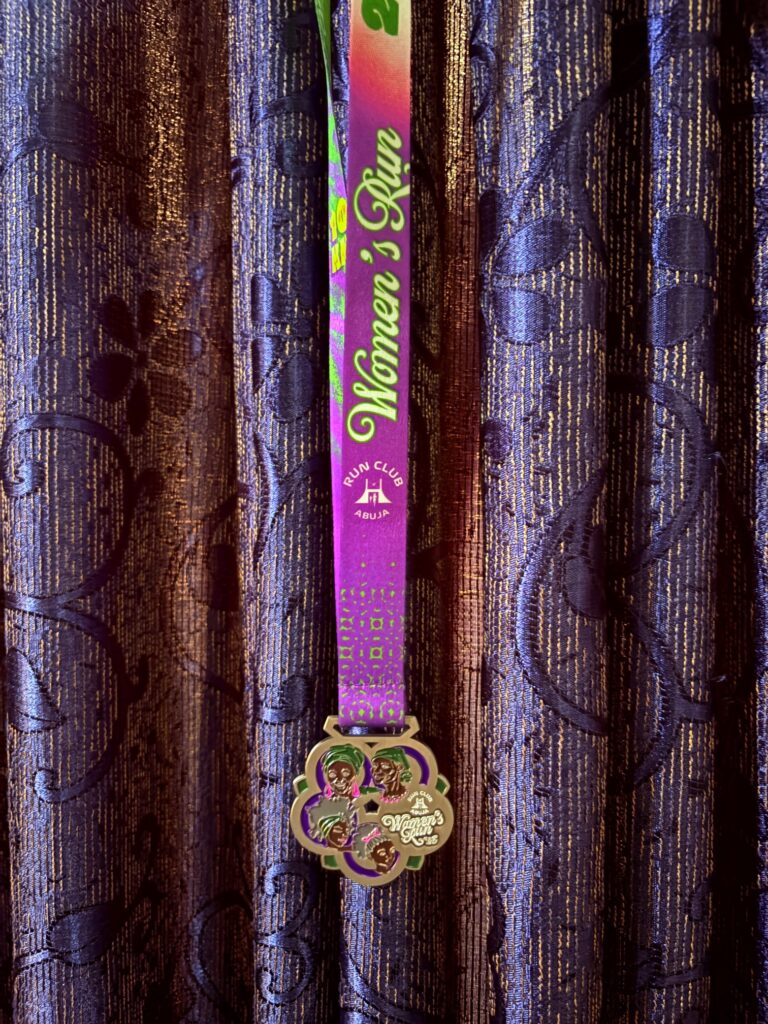
What I earned on the asphalt wasn’t only a calorie burn and a gorgeous medal. I also got a masterclass full of life lessons that I know will stay with me. Here are six things I learned while running the Run Club Abuja 10KM race.
1. You really can’t do it alone
I wouldn’t have been on that run if it wasn’t for my aunt. We’d done 5k runs together, leisurely strolls with the occasional jog,but this felt different. On the day of the run, I realized that she didn’t just extend an invite to just run—she brought me into her world. Watching her navigate the crowd at Eagle Square, introducing me to her circle of fabulous older women, I realized that community is the ultimate performance enhancer.
Throughout the run, there was a beautiful, unspoken support system. Whenever the distance between us stretched too thin, she would scan the crowd, pausing to ensure I was hydrated and breathing right. She was my pacer, my photographer, and my partner during the warm-ups.
The run reminded me that no man is an island. Had I gone alone, I might have given up when my lungs started to protest. But surrounded by the collective energy of hundreds of women, I realized we go further when we go together. My network expanded that day, not just in numbers, but in spirit.
2. Don’t try to wing hard things
There is a famous adage: If you fail to prepare, you are preparing to fail. It sounds like something a secondary school biology teacher would scream, but when push comes to shove, a terrain doesn’t lie. I knew about this run a month in advance, and for the first time in my life, I actually respected the timeline.
I started taking my tennis sessions more seriously and hit the pool more frequently to build up my lung capacity. Because I had put in the “boring” work weeks prior, the 10km didn’t feel like the so-called death march it was for many inexperienced runners. Life, much like a long-distance run, rewards the work done in the dark. When the big moments come, you don’t want to be gasping for air; you want to be ready.
3. We have a serious littering problem
As much as the morning was a celebration of wellness, it provided a sobering look at our civic habits. My least favorite part of the experience wasn’t the pins and needles or the uphill climbs; it was the trail of dirt the runners left behind.
As we ran, I watched participants indiscriminately toss banana peels and plastic electrolyte bottles onto the streets. It was a jarring contradiction: we were there to celebrate health and wellness, yet we were mistreating the very environment that hosted us. Nigeria’s poor waste disposal culture isn’t only a government failing but also a personal one. This is a wake-up call for both the government and event organizers. While the runners need to do better, we need a system that makes doing better easy. To marathon organizers and government authorities, we need more than just water stations, we also need waste disposal zones every few kilometers. Organizers must prioritize “Green Races” by placing visible, frequent bins and deploying cleanup crews immediately after the pack passes. Wellness shouldn’t come at the cost of our streets.
4. Your mind gives up before your body does
Around the 7km mark, my body started a very persuasive negotiation with my brain. “You’ve done enough,” it whispered. “Nobody will care if you walk the rest.” This is called “The Wall.”
Listening to the Nike Run app’s energy-boosting playlist, I realized that physical fatigue is often a suggestion, not a command. Crossing that finish line taught me that our limits are often arbitrary lines we draw for ourselves. Whether it’s a career goal, a creative project, or a 10km run, the hardest part isn’t the physical toll, it’s the mental strength required to tell your tired self “not yet.”
5. Mastery is about delayed gratification
Midway through the run, the Abuja heat started to bite, and my throat felt like sandpaper. Every time I saw a water station, my instinct was to grab three bottles and chug them until I couldn’t breathe. But I knew better. I knew that if I over-hydrated, I’d end up with a sloshy stomach and painful cramps that would end my run right there.
I had to practice the discipline of “not yet.” I took small, measured sips—just enough to keep going, but never as much as I actually wanted. It was a physical lesson in delayed gratification. Sometimes, to reach the big goal (the finish line), you have to deny yourself the immediate comfort (the gallon of water). Learning to manage your desires in the heat of the moment is the only way to finish the race.
6. Running for a cause changes the energy
The most profound lesson came from the “why” of the event. This wasn’t just about personal bests or aesthetic goals; the proceeds were going toward sheltering widows.
There is a different kind of stamina that kicks in when you realize your movement is contributing to someone else’s stability. It transformed the run into a selfless act of service. This experience taught me that when we do things for a cause greater than our own ego, we tap into a deeper well of energy. Doing things for ourselves can be satisfying, but doing things with a higher purpose is what makes us feel truly fulfilled. It transforms a mundane task into a mission. It’s probably why my post-run breakfast felt like more than just a meal. Honestly, eating with my aunty and her friends afterwards was pretty much a celebration of the impact our legs had made for vulnerable women.
In the end, the Abuja Run Club event wasn’t just another race. For me, it was a reminder that when you combine a clear purpose, a solid community, and a bit of prior preparation, you can go much further than you ever thought possible. Even if it’s “only” 10km.