

When Netflix dropped its latest African drama, The Polygamist, the title alone served as a lightning rod for controversy. In a continent where the lines between traditional structure and modern autonomy are constantly blurred, a story about a man juggling multiple wives usually promises a predictable cocktail of domestic rivalry, witchcraft rumors, and patriarchal triumph. And of course, the show delivered on all fronts.
But as the credits roll on the final episode, a chilling realization sets in: The Polygamist isn’t actually about polygamy. It isn’t even really about Jonasi, the man at the center of the storm. Instead, the series serves as a brutal, unblinking autopsy of the African woman’s “endurance.” It is a lens focused on the exhausting, generational expectation that a woman’s worth is measured by how much she can suffer in silence, how much she can forgive in public, and how well she can decorate the walls of a crumbling home.

Through the lives of Joyce (Gugu Gumede), Matipa (Kwanele Mthethwa), and Essie(Kwanele Mthethwa), we are forced to confront the ride or die culture that has become the infrastructure of many African marriages. It is a culture that tells women that making it work is the highest calling—even when there is nothing left to work with.
Joyce: The Golden Handcuffs of Perfection
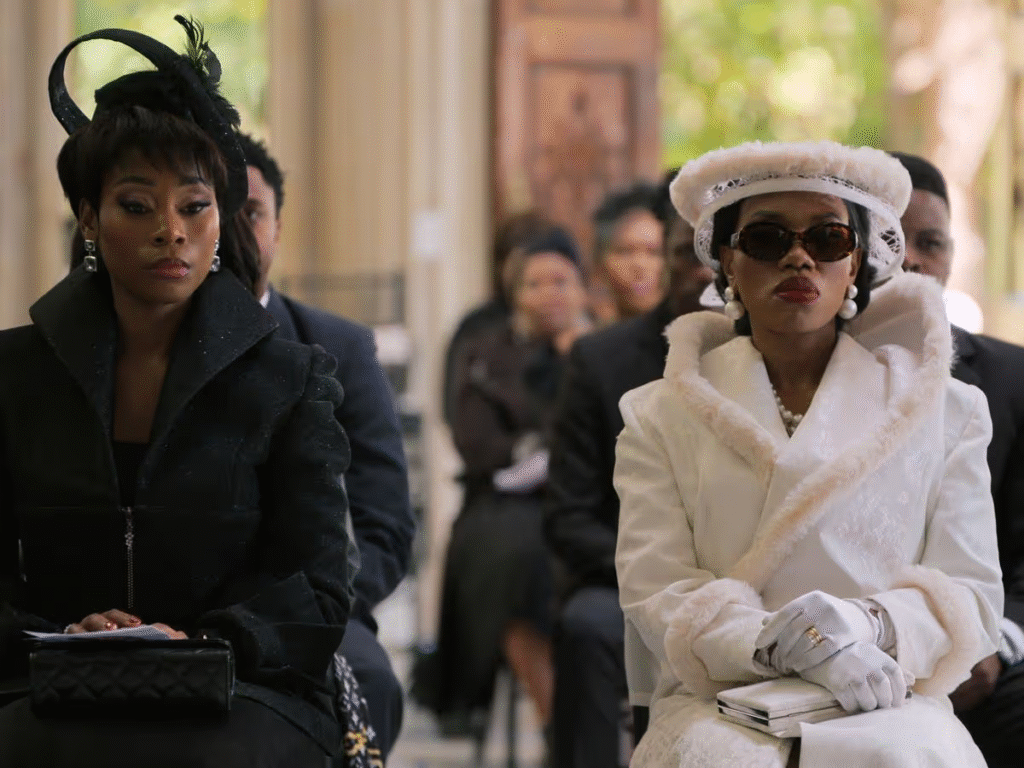
Joyce is the woman every girl is told to be. She is beautiful, professional, and poised. On the surface, her life is a mood board for Black Girl Magic. She is the “Good Wife” who has built a fortress of success alongside a man she believes adores her.
However, Joyce represents the most insidious form of the unliberated African woman: the one who reveres the image of the family more than her own peace of mind. For Joyce, a crack in the marriage is not an indictment of her husband’s character; it is evidence of her own failure as a woman. This is the heavy burden of “what will people say.”
We see this most clearly in her willful blindness. When Joyce encounters Matipa at the baby store and senses the thick, awkward tension between herself, her husband, and this stranger, her intuition screams. A liberated woman might have investigated. Joyce, however, chooses to silence her gut to protect the illusion. Even after Jonasi proves himself a bastard in the most literal sense—walking out on his children and allowing his side-chick the audacity to insult his wife—Joyce takes him back. Why? Because in the script Joyce has been handed since birth, the “Strong Woman” is the one who endures the unendurable. She treats her husband’s betrayal like a temporary illness she must nurse him through, rather than a fundamental violation of her humanity.
Matipa: The Delusion of the Special Girl

Then there is Matipa—the cunning, ambitious social climber who believes she has hacked the system. Matipa is the modern iteration of the “other woman” who thinks her beauty and intellect make her immune to the patterns of a serial predator.
Matipa’s tragedy is a lesson in the honeymoon phase delusion. She falls in love with the version of Jonasi that was performing for her, convinced that she is the “special” one—the one he will finally change for. She ignores the most basic rule of relationship dynamics: how a man treats his wife is eventually how he will treat you.
Despite her intelligence, Matipa is blindsided when the reality of Jonasi’s narcissism hits. The man who promised her the world leaves her to navigate the physical and emotional wreckage of postpartum life alone. The scene where Jonasi insists on a blowjob immediately after she is discharged from the hospital is perhaps the most visceral representation of male entitlement in the series. It strips away the romance of being the “preferred” wife and reveals the truth: to a man like Jonasi, women are not partners; they are utilities. Matipa loses her reputation, her career, and eventually her children, all because she believed her “strategy” could outrun a man’s lack of character.
Essie: The Footmat of Fidelity
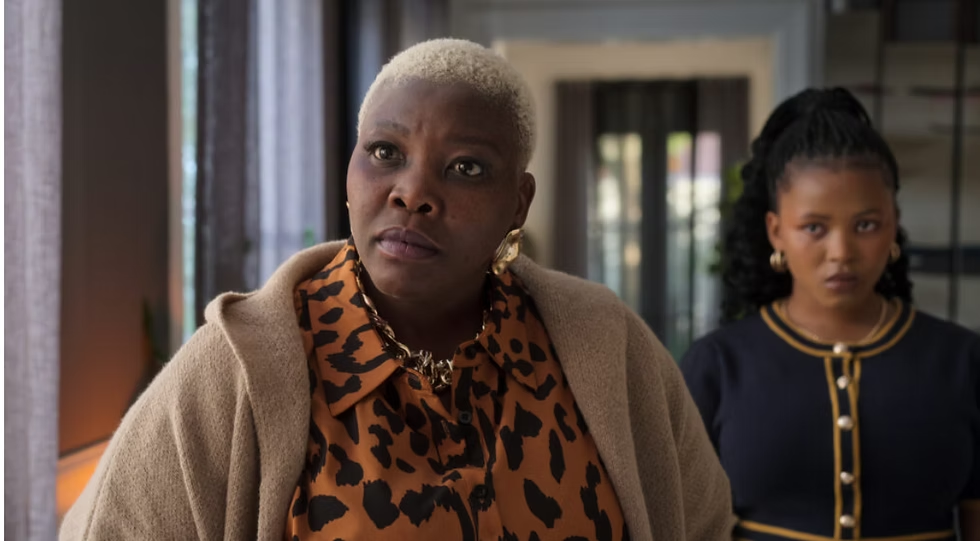
If Joyce is the face and Matipa is the fire, Essie is the ghost. Essie is the “good woman” in the traditional sense—so centered on her husband that she has completely erased herself. She is the ultimate evolution of the woman who stays for the children and stays for God.
Essie has lost the ability to take offense on her own behalf. She is so complacent in her own erasure that she accepts Jonasi’s neglect as her natural environment. Even up until his death, she remains his footmat, offering a soft place for him to land after he has finished trampling over the other women in his life.
Essie’s character is a haunting critique of the way we socialize girls differently from boys. From childhood, girls are taught to be “helpers,” to be “patient,” and to “understand” a man’s nature. Boys, meanwhile, are socialized to explore, to conquer, and to expect forgiveness as a birthright. Essie is the result of that socialization taken to its logical, tragic conclusion: a woman who exists only in the periphery of a man’s life.
Who Needs Villains When Men Like This Exist? A Ranking of Jonasi’s Most Outrageous Acts
One of the reasons The Polygamist works so well is that it doesn’t need a traditional villain. There is no wicked stepmother, no evil mistress pulling strings from the shadows, no supernatural force ruining people’s lives. There is just Jonasi.
In many ways, the women spend the entire series reacting to damage that Jonasi creates and then expecting themselves to be the ones to clean up the mess. To fully appreciate the scale of the chaos, here is a completely unofficial list of some of Jonasi’s most outrageous offenses (in no particular order of awfulness)
1. Infecting the Women He Claimed to Love With Gonorrhea
Jonasi had unprotected sex with multiple women while fully aware that he was sleeping around. The result was devastating: he infected women who trusted him with an STI. The betrayal is staggering because this isn’t simply infidelity. It is recklessness with other people’s lives and health. The women are expected to forgive cheating, but how exactly do you forgive someone for endangering your life?
2. Secretly Marrying Essie While Maintaining His “Respectable” Family
Jonasi’s treatment of Essie deserves its own psychological study. After marrying Joyce, he returned to Essie, married her in secret, and then recruited his brother into an elaborate deception that lasted for years. He allowed everyone to believe his brother was Essie’s husband, except Essie’s own children.
Imagine being so committed to living a double life that you force your loyal brother to participate in it. Imagine being Essie and accepting it. What the hell?
3. Sleeping With an Underage Girl—Who Was Also His Daughter’s Friend
There are some actions that move beyond bad husband territory into outright depravity. Sleeping with an underage girl is one of them. Sleeping with your daughter’s underage friend somehow makes it worse.
The storyline is disturbing because it reveals that Jonasi’s problem is not simply infidelity. He believes his desires matter more than other people’s safety, boundaries, and dignity. It doesn’t get more sinister than that.
4. Convincing Joyce to Have Another Child While Impregnating His Side Chick
Jonasi deserves recognition for a level of audacity that should probably be studied academically. After betraying Joyce, he convinced her to trust him again. He encouraged her to rebuild their family and have another child. At the very same time, he was impregnating Matipa. The issue is not merely that he cheated. It is that he actively participated in rebuilding trust while simultaneously destroying it. That takes commitment. Just not the good kind.
5. Demanding Oral Sex Immediately After Matipa Gave Birth
If there were an Olympic event for selfishness, Jonasi would be a medal contender. Matipa had barely recovered from childbirth when Jonasi insisted on sexual gratification from her. The moment is shocking because it demonstrates how little regard he has for her wellbeing. Her body had just gone through one of the most physically demanding experiences possible, yet his focus remained squarely on his own needs.
6. Physically Abusing Matipa and Essie
The violence in Jonasi’s relationships reveals the reality beneath his charm. When his wives began to get a grip on their own reality, he resorted to hitting them.
7. Stealing His Brother’s Girlfriend
As if betraying multiple women wasn’t enough, Jonasi somehow found time to betray the most loyal man in his life. His brother repeatedly covered for him, protected his secrets, and sacrificed his own reputation to support Jonasi’s lies. Jonasi repaid that loyalty by stealing his girlfriend, Matipa. At some point, you have to wonder whether the man had any functioning sense of shame.
Anyways The Real Problem Isn’t Jonasi
The easiest reading of The Polygamist is that Jonasi is a terrible man. And he is. But the more interesting question is why so many women stayed despite everything. Why was Joyce expected to forgive? Why was Essie expected to wait? Why was Matipa expected to endure? Why are women so often taught that loyalty is a virtue even when it is actively harming them?
Because ultimately, The Polygamist is not a story about a uniquely awful man. Every community has a Jonasi. Every generation has a Jonasi. The real story is about the women who are taught to survive him. And perhaps the most radical lesson the series offers is that survival should not be the highest standard women aspire to in love.
Men like Jonasi deserve to die alone.
The Culture of the Ride or Die

We see it in the way we glorify “suffering” in relationships, calling it “building with a man.” African society often treats marriage like a war of attrition. The woman who stays the longest, suffers the most, and dies with the “Mrs.” title intact is seen as the victor. But The Polygamist asks us: what exactly is she winning?
Is it a win to stay for the children, only to raise them in a home where they learn that love looks like humiliation? Is it a win to keep the “perfect” home while your internal world is a graveyard of unmet needs and silenced screams?
In the series, Jonasi meets a gruesome end, orchestrated by a Joyce who finally snaps. But we must not mistake his death for a “happy ending” or a “win” for the women. In reality, and in the show, the women have already lost. They lost years of their lives to a man who didn’t deserve a day. They lost their sisterhood to competition for male validation. They lost their sense of self to a cultural script that told them their endurance was their greatest virtue.
Rejecting the Endurance Template
As we dissect The Polygamist, we must be careful not to hold any of these women up as a template for survival. Joyce’s endurance is not a blueprint; it is a cautionary tale about the cost of maintaining a facade. Matipa’s strategy is not a way to “win” a man; it is a fast track to losing oneself. Essie’s self-erasure is not “godly” patience; it is a slow suicide of the soul. Even Lindani’s hope, was a dangerous thing as it was not anchored in boundaries and self-respect.
The reality is that when we center our lives entirely around the validation of men who view us as interchangeable, we lose on all fronts. Jonasi’s death doesn’t fix the trauma he left behind, nor does it restore the parts of these women they cut away to fit into his life. The Polygamist should serve as a closing chapter on the era of the “Ride or Die.” It is time African women stop being praised for how much they can endure and start being supported in what they deserve. We must stop teaching our girls that their hearts are shock absorbers for men’s bad behavior.
If there is any lesson to be taken from Joyce, Matipa, and Essie, it is this: the perfect home is not worth the price of a broken woman. It is time to stop building monuments to our own suffering and start building lives where we are the main characters—not the supporting cast in a man’s chaotic play.