

Trigger Warning: This article discusses sexual violence and victim-blaming, which may be distressing for some readers.
In a country where sexual violence remains a pervasive shadow over the lives of women, the institutions meant to protect students should be the first line of defense. However, a recently withdrawn notice from the University of Lagos (UNILAG) suggests that, even at the highest levels of academia, the burden of safety is still being placed squarely on the shoulders of the potential victim.
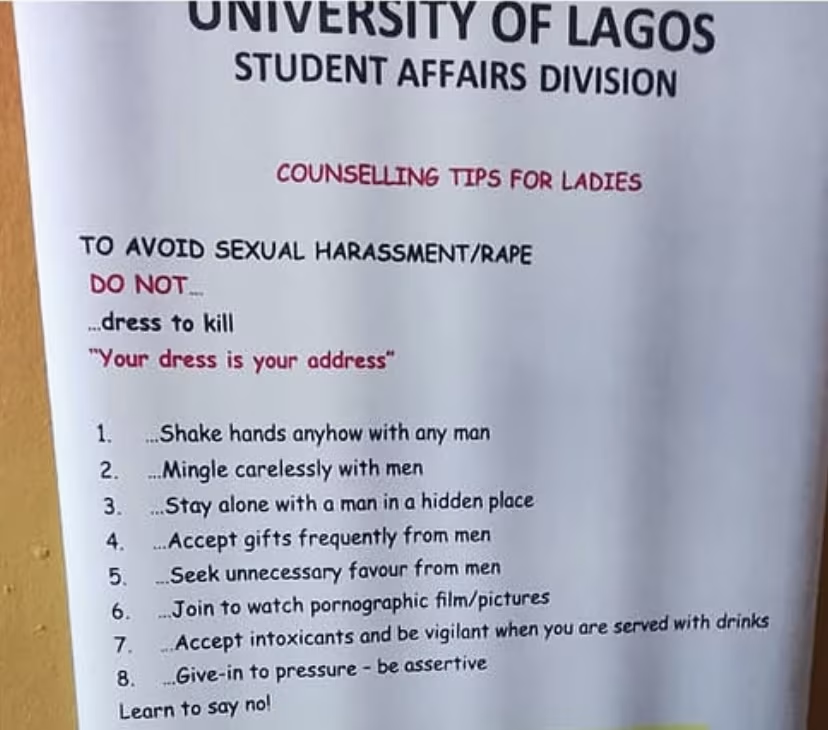
The notice, titled “Counselling Tips for Ladies to Avoid Sexual Harassment/Rape,” was issued by the university’s Student Affairs Division and Counselling Unit. It offered eight directives for female students, ranging from the mundane to the absurd. Among them: “Do not dress to kill,” “Do not shake hands anyhow with any man,” and “Do not seek unnecessary favour from men.”
Following a swift and fierce backlash on social media, UNILAG withdrew the notice, stating it did not reflect the institution’s official position. But while the banner is gone, the ideology behind it remains pinned to the fabric of Nigerian society. The withdrawal of a physical sign does not equate to the dismantling of the victim-blaming mindset that authored it.
The Architecture of Victim Blaming
The UNILAG advisory was a manifesto of purity culture masquerading as safety tips for women. By instructing women not to “shake hands” or “seek favours,” the university essentially suggested that sexual assault is a consequence of a woman’s behavior.
If a woman is harassed after shaking a man’s hand, is she then responsible for the assault because she failed to follow the “tips”? This is the insidious nature of victim-blaming. It creates a checklist for women to follow, and when they are inevitably harmed—because rapists do not care about handshakes or hemlines—society uses that checklist to disqualify their trauma.
What was most glaringly absent from the banner was any instruction for the perpetrators. There were no tips for men on respecting boundaries and no warnings about the consequences of assault. By focusing entirely on the “ladies,” the university signaled that sexual violence is a woman’s problem to solve, rather than a man’s problem to stop.
A History of Educational Institutional Failure
This notice did not exist in a vacuum. It emerged from an institution—and a national university system—that has long struggled with Sex for Grades and predatory behavior by staff.
In 2019, the BBC’s Sex for Grades investigation exposed the rot within West African universities, including UNILAG. Since then, the university has made strides, dismissing lecturers and strengthening reporting frameworks. Only recently, an Ikeja High Court heard the testimony of a 20-year-old Unilag student who alleged she was raped by a lecturer, Dr. Samuel Ojogbo, in an underground office.
When an institution with this history tells women to “not stay alone with a man in a hidden place,” they unknowingly acknowledge a systemic failure to make their own campus safe. If a student cannot meet a lecturer in an office without fear of assault, the problem is not the student’s presence, it is the lecturer’s predatory behavior and the environment that allows it to flourish.
The Broader Nigerian Context: Rape Culture as a Default
The UNILAG incident is a microcosm of a larger Nigerian reality. We live in a culture where the first question asked after a report of rape is often, “What was she wearing?” or “Why was she there?”
Rape culture in Nigeria is reinforced by:
- Moral Policing: The belief that “decent” women don’t get raped, which implies that “indecent” women are fair game.
- Power Imbalances: In universities, the power dynamic between a lecturer and a student makes “consent” a murky concept when grades and futures are at stake.
- Religious and Cultural Conservatism: Using modesty as a shield for abusers, suggesting that men are uncontrollable animals who react instinctively to a woman’s appearance.
This culture silences survivors. When the very offices a student should turn to for help—the Counselling Unit and Student Affairs—are the ones publishing banners that blame her “handshakes” for her assault, the message is clear: If you come to us, we will find a way to make this your fault.
Why We Must Fight Back
The backlash against the UNILAG notice is a sign of hope. It shows a growing demographic of Nigerians who refuse to accept the status quo. However, the fight must go beyond social media outrage.
We must demand that institutions shift their focus from policing women to programming men. Education on consent, healthy masculinity, and the legal definitions of sexual assault must be mandatory. Universities must invest in lighting, security, and transparent disciplinary measures that punish predators swiftly and publicly. True anti-sexual assault counselling tips for a campus should include:
- Mandatory anti-sexual harrasment training for all staff and students.
- A clear definition of consent (Yes means Yes; anything else is No)—Periodic lectures on consent is welcome. Consent Banners posted all over campus would be great.
- A transparent accountability framework that provides clear reporting mechanisms, survivor-centred support, and appropriate disciplinary action against predatory staff and students.
- Strict punishment of ‘aro’ participants as well as other understated forms of rape culture in universities.
- Sensitizing on personal safety tips (without victim-blaming). Examples are: Let trusted friends know your whereabouts; Stay with people you trust at parties; Watch your drink being prepared; Trust your instincts if something feels wrong; Have emergency contacts readily available; Arrange safe transportation home.
- Trainings on how to properly support victims of sexual assault. Examples are: Listening without interrupting. Believing them. Asking how you can help. Respecting their choices. Maintain confidentiality
Furthermore, we must dismantle the safety narrative that relies on female restriction. A woman’s safety should not depend on her being a recluse or a modest dresser. It should depend on a society that holds rapists accountable.
Conclusion
The withdrawal of the UNILAG notice is a small victory, but the “tips” it contained are still being whispered in homes, churches, and classrooms across Nigeria. As long as we continue to teach women how to “not get raped” instead of teaching people “not to rape,” we are failing.
Sexual violence is not a wardrobe malfunction or a result of a handshake. It is a crime of power and entitlement. Until our institutions recognize that, their “counselling” will remain part of the problem, rather than the solution. It is time to stop asking women to carry the weight of their own protection and start demanding that the world stop being a place they need protection from.